

Robot Trade Files: Distinguish License IDs and LicenseRef
2026-11-02
Robot Trade Files: Distinguish License IDs and LicenseRef
LicenseRef and a short identifier from the SPDX License List have different roles when reading software documents in a robot trade file set. A familiar-looking field should not be treated as a complete explanation of permissions or of the equipment delivery. This article proposes a technical reading exercise with a fictional document. It examines no actual contract, software package, or license grant and gives no conclusion about a transaction’s legal rights.
Start with the object described by the field
Before looking up an identifier, ask what the prepared document says it describes. A field associated with one software file should not silently become a statement about a controller image, an entire installation, or the robot itself. Keep the document’s stated object beside the field during the reading exercise.
The learner should also distinguish information supplied in a document from an independently verified conclusion. Ask which object a copied summary would describe after the surrounding headings were removed. If that relationship becomes unclear, retain the headings in the teaching note. The fictional exercise has no actual supplied file to examine. It can teach the roles of identifiers without pretending that an identifier has been found in a real delivery.
Write the reading question narrowly: what representation is being used, and what material would explain it? This is a more useful starting point than asking a short string to settle every licensing question associated with a trade.
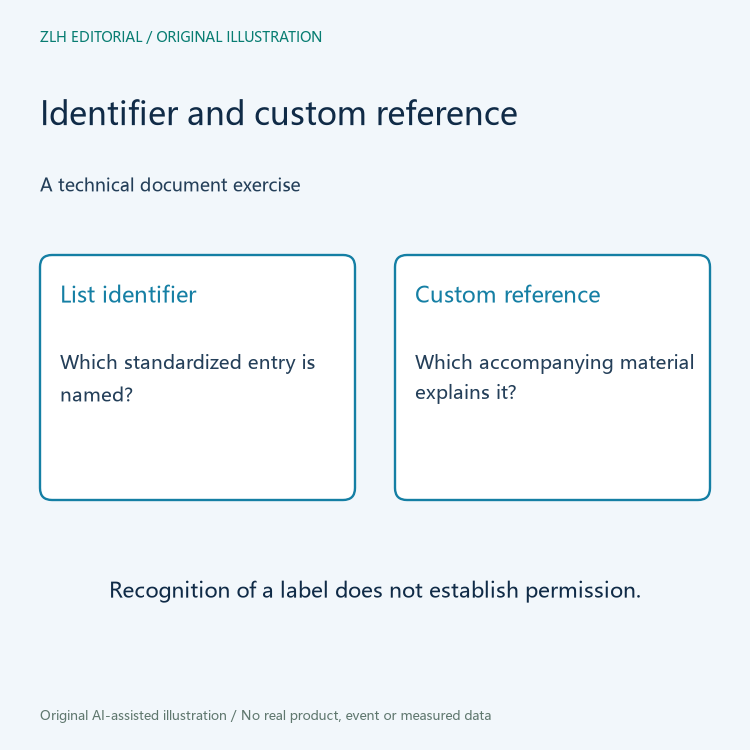
Recognize the list identifier as an identification mechanism
The SPDX License List supplies standardized short identifiers alongside license names, text, and canonical URLs. The list’s stated purpose supports reliable identification. It does not make the mere presence of a string evidence that a particular file is actually governed by the referenced terms.
In a prepared classroom example, a learner can describe the difference between the identifier and the full material it identifies. Keep that distinction visible rather than replacing a full reading with recognition of a familiar abbreviation.
No particular license is selected for a robot delivery here. The article does not compare obligations, recommend a license, or infer permission from a catalog entry. Those questions depend on the actual materials and applicable context, beyond this representation exercise.
Follow a custom reference to its explanatory material
SPDX 2.3.1 Annex D includes user-defined license references in its expression model. A custom reference is therefore a documented kind of representation, not automatically a misspelled identifier from the public list.
When the prepared example uses that kind of reference, the learner should ask which accompanying material explains it. Reading the label alone cannot supply missing text. If the explanatory material has not been provided, record that as an unresolved document question.
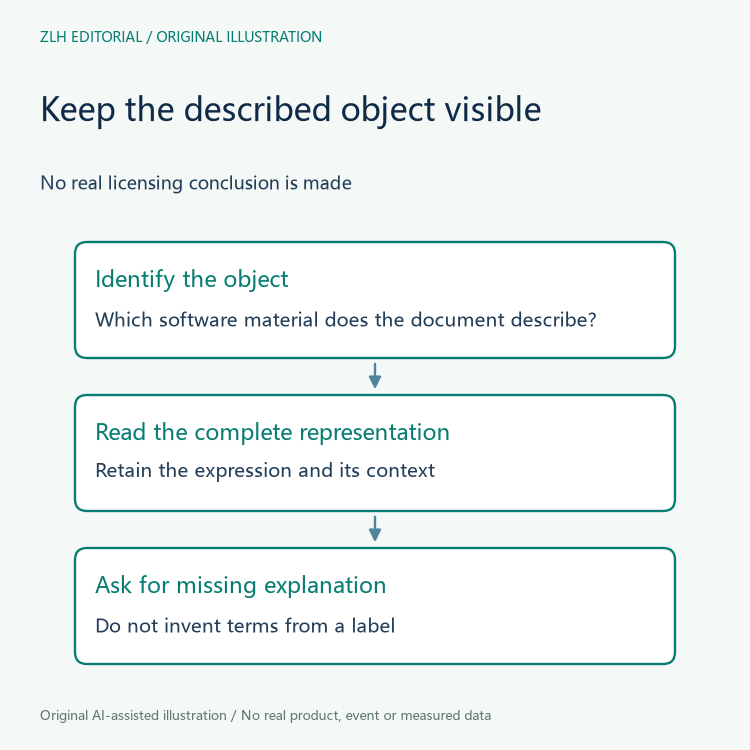
The exercise should preserve the reference’s document context. A custom label copied into a separate summary may lose the relationship needed to understand it. Do not assume that two similarly spelled labels in unrelated documents identify the same material.
Do not flatten an expression into one recognized word
The annex also describes expressions built from identifiers, references, and specified operators. For the reading exercise, retain the complete supplied expression instead of extracting whichever component looks familiar. Removing surrounding structure can change what the document represents.
A learner who cannot explain the representation should return to the applicable specification and the prepared document context. Guessing from a fragment is less useful than identifying the precise question that needs clarification. This article provides no expression for a real delivery and performs no automated licensing scan.
Likewise, a tool accepting a field’s syntax would answer a representation question. It would not establish the correctness of the document’s association with an actual file. A practical review should keep those two questions apart even when both eventually need attention.
Prepare a technical question for the document owner
A useful clarification request identifies the described object, the complete field, and the missing explanatory relationship. It should not replace missing information with an assertion that a permission exists or does not exist. The document owner needs to know exactly which representation the reader cannot follow.
For the fictional exercise, ask a colleague to reconstruct the distinction between a list identifier and a custom reference. They should be able to say where the explanation would come from in each case, while leaving any actual rights question unanswered.
The resulting note is a document-reading aid, not a contract assessment, a hardware certification, or approval to use or distribute software. Related material appears in our robot trade-document section and the article directory. Both original diagrams contain no real licensing field, package inventory, contract terms, or permission finding.


