

Robot Trade Data Acceptance: State the CSV Encoding
2026-11-02
Robot Trade Data Acceptance: State the CSV Encoding
CSV encoding needs to be stated when a robot-trade document table moves between systems. A file that opens in one application can still leave another receiver uncertain about how its bytes were interpreted. Before accepting the table delivery, a buyer should ask which encoding the supplier intended and what the receiving application actually used. This article proposes that review. It reads no transaction file and decodes no real shipment data.
Separate the byte representation from the table’s business meaning
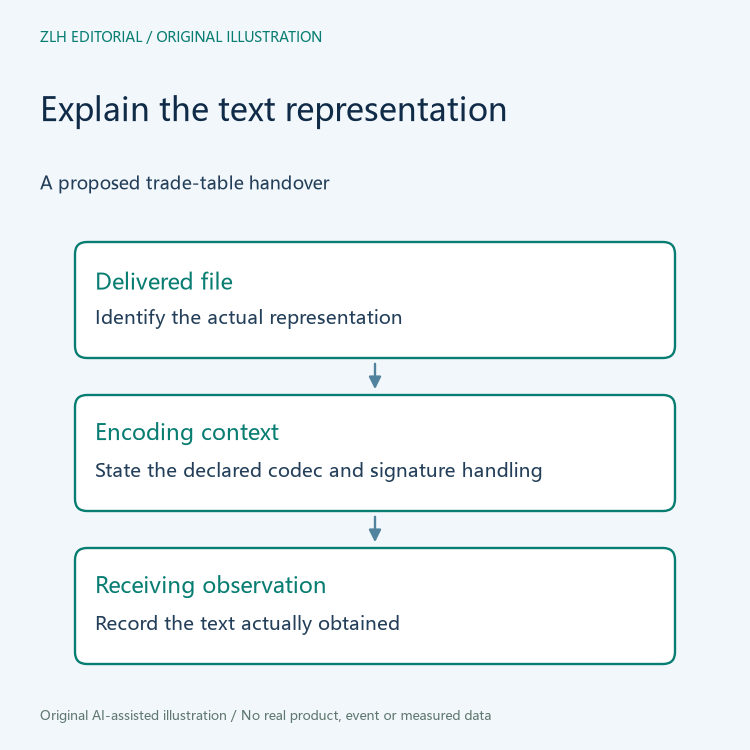
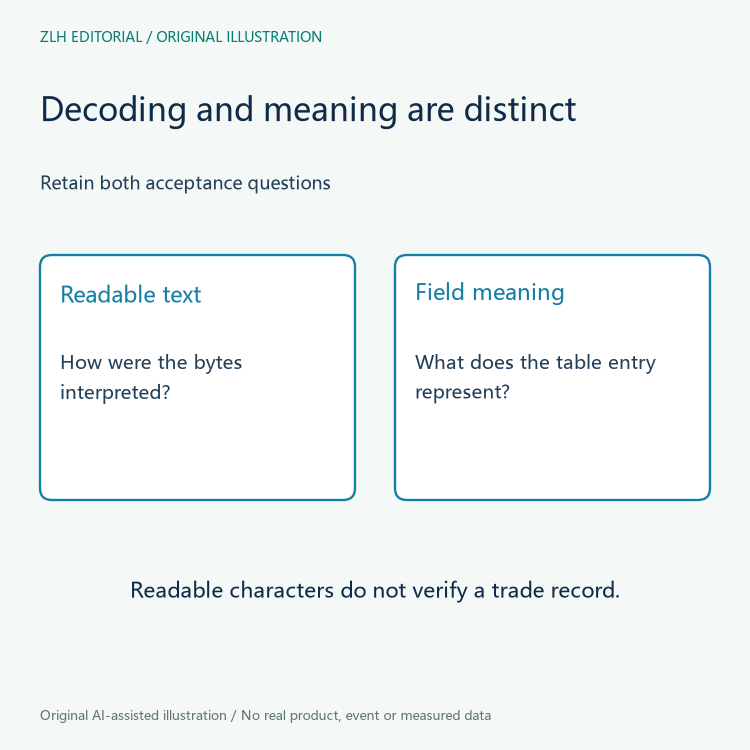
Ask the supplier to identify the delivered file and the intended text encoding. That explanation belongs to the representation layer. It does not establish what a shipment status, item description, or document reference means. The receiving team needs both questions answered without merging them.
A filename ending in CSV should not be treated as a complete import specification. The supplier should identify the actual dialect information needed for the agreed receiving task. The buyer should not guess a successful interpretation merely because rows and columns appear in a preview.
Ask the receiving application owner which import choices are automatic and which require an explicit selection. Keep that explanation with the supplier’s declaration. A later operator should not have to reproduce an undocumented sequence of guesses to obtain the text that an earlier reviewer happened to see.
For the hypothetical acceptance meeting, keep the table values unspecified. Prepare an encoding question in the handover note rather than invent a trade record. Plausible item numbers or shipping dates would make the example look operational without providing evidence about a real delivery.
Ask how the encoding is declared for this delivery
The W3C CSV on the Web metadata specification describes an encoding property in its dialect description. This gives a documented way to discuss text encoding alongside other table-reading conventions. The receiver should ask what declaration applies to the actual supplied file.
A declaration and an observation remain distinct. The supplier can state the intended encoding, while a later authorized receiving check records what the application actually did. The acceptance note should retain both contexts rather than treat an intended setting as proof of a completed import.
If the file and accompanying instructions disagree, keep the discrepancy visible. Do not quietly select the option that produces the most familiar-looking text and then report the original delivery as unambiguous. The supplier should clarify or revise the relevant material.
Keep the UTF-8 signature question specific
The Python codecs documentation explains utf-8-sig: encoding writes an initial UTF-8 signature, while decoding skips that initial byte sequence when present. It also explains that this UTF-8 signature is not needed to determine byte order.
Ask the supplier which receiving convention is intended and whether the actual processing path accounts for the relevant initial signature. Do not generalize the behavior of one named codec to every application or encoding. The handover needs the actual implementation context.
No byte sequence is inspected in this article. A documented codec behavior is not an observation about a real trade file. A later review should identify the input representation, selected decoding convention, and actual result without fabricating a successful import transcript.
Review decoded text before accepting field interpretation
Once an authorized receiving exercise has obtained text, the reviewer still needs the table’s field definitions and intended relationships. Readable characters do not establish correct column assignment, document status, or transaction identity. Those questions need the appropriate source context.
Keep transformations attributable. If the receiving process creates a new representation, identify how it relates to the delivered file. Re-saving a preview can change the representation, so the result should not silently replace the original object in the acceptance record.
Where interpretation remains uncertain, ask for a focused clarification. Do not fill missing context with guessed values or silently remove an unexpected character. A transparent open item is more useful than a complete-looking table whose relationship to the supplied bytes is unclear.
Close the representation task with its limits intact
The proposed handover should identify the file, declared encoding, relevant signature convention, receiving implementation, and actual observation. It should also preserve the separate questions about field meaning. Another reviewer can then tell what the text-processing result supports.
If the supplier changes the export arrangement, ask which earlier receiving checks need repetition. Preserve the previous representation and its instructions with their own record. A stable filename should not imply that the same decoding assumptions apply indefinitely.
More delivery notes appear in our robot trade documents section and the reading directory. Both original illustrations contain no real CSV bytes, customs records, shipment values, decoded table, or completed transaction acceptance.


