

Robot Trade Links: Read Query and Fragment Separately
2026-11-04
Robot Trade Links: Read Query and Fragment Separately
A robot-document handover can contain two links that look almost identical except for text after a question mark or a number sign. Before calling them duplicate downloads or different file versions, distinguish query and fragment components. Their roles differ, and neither component is a universal version label. This article reads a fictional documentation link. It does not retrieve a trade attachment, inspect a private portal or confirm that any supplier has delivered a file.
Preserve the full reference before interpreting its label
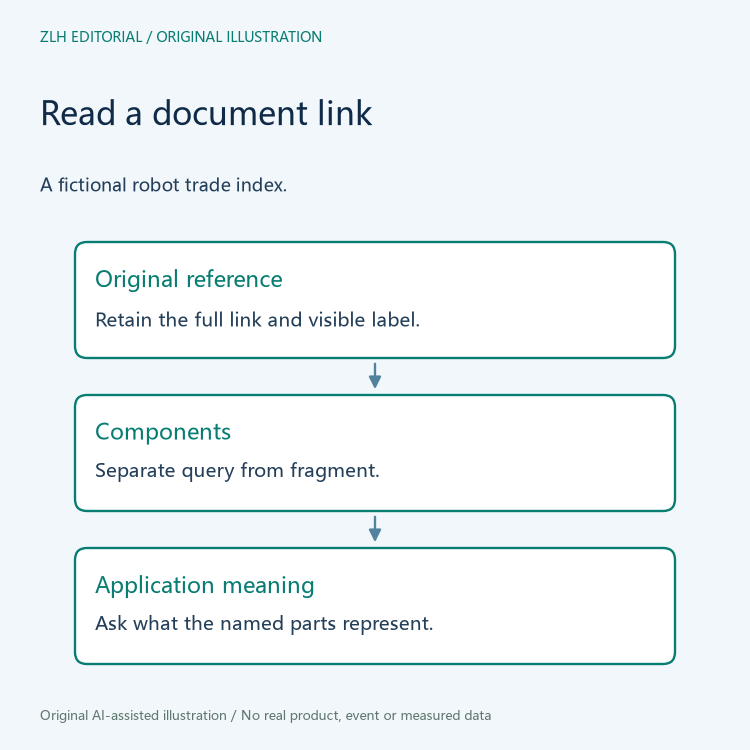
Imagine a hypothetical document index with an entry called Configuration notes. Its link includes a path, a query component and a fragment component. The index label describes what the author wants the reader to expect, while the link supplies the actual reference. Keep both in the review note. A shortened display can hide exactly the part needed to understand why two readers reached different views.
Do not remove unfamiliar punctuation while transcribing the reference. The question mark and number sign have structural roles in the generic syntax. Equally, do not assume that an invented word such as revision inside a component establishes a genuine document edition. Ask the source owner how the application uses that term. An application-specific parameter needs its own explanation; its appearance in a URL is not an independent record of publication history.
Identify the generic component boundaries
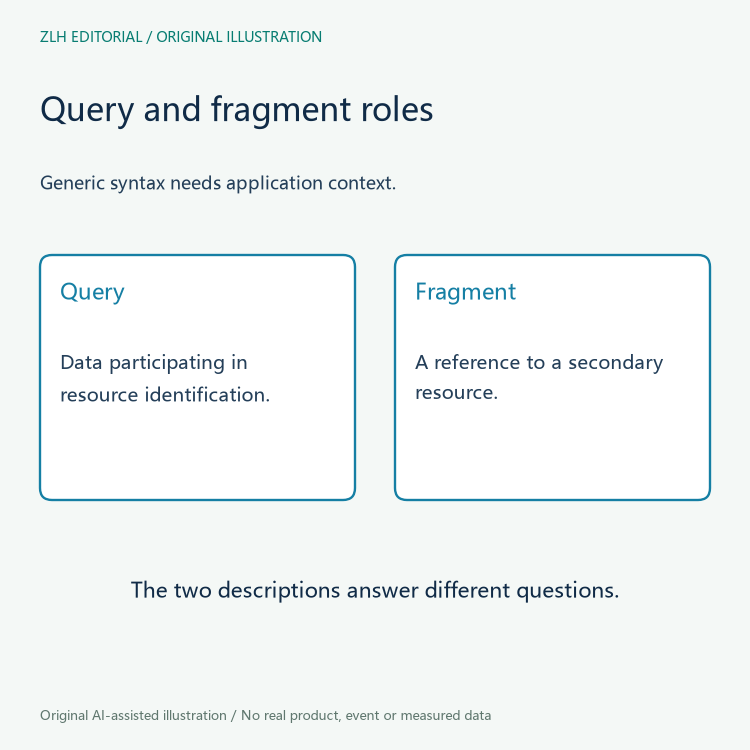
RFC 3986 describes the query component after a question mark and the fragment component after a number sign. It explains fragment identification of a secondary resource and its separation before dereferencing the primary resource. Fragment meaning depends on the representation's media type. These are generic reference rules rather than a description of a particular supplier's application.
For the fictional index, a fragment might be intended to point to a part of the retrieved document. That intention does not prove that the target exists in every representation of that document. A query might participate in identifying the resource under the application's conventions. The reviewer should report these as different questions. A successful retrieval of the primary document would not, by itself, establish that a fragment identified the section the index promised.
Read a parser result within its documented purpose
The Python urllib.parse reference documents urlsplit as separating scheme, network location, path, query and fragment. It notes that percent-encoded sequences are not decoded by that splitting operation. The reference also warns that URL parsing functions do not perform validation. A component listing is therefore a reading aid, not evidence of a trustworthy or reachable destination.
If a supplier provides such a listing, ask which input string and parser settings produced it. Do not confuse the original reference with a normalized or reconstructed display. Keep the original available so a later reviewer can explain any difference. This article includes no parsing commands or executed results; the hypothetical listing simply illustrates why a technical note should identify what stage of representation it describes.
Separate a changed reference from a changed document
Suppose the fictional handover is revised so the fragment names a different section while the preceding components remain the same. That change can alter the intended reading target without establishing that the underlying document bytes changed. Conversely, an unchanged link does not establish unchanged content at its destination. Reference identity, retrieved representation and document-edition identity need their own evidence.
A trade reviewer can request an edition description or a separately supplied file-identity record when those questions matter to the agreement. Do not substitute a query label for that evidence. If two recipients report different views, retain the reference each actually used and the representation each describes. Avoid attributing the difference to a supplier error until the relationship between those observations is understood. Several application behaviors could be possible, but none is inferred here.
Make the handover's link explanation reproducible
A useful link note contains the visible index wording, the full reference, the identified components and the source of any application-specific explanation. It also states what was not checked, such as retrieval, fragment resolution or attachment contents. When the supplier corrects a link, retain the prior reference with the correction so earlier correspondence remains understandable. A replaced link is a documentation change whose scope should be named.
The conclusion can be that a reference is now explained while delivery or content acceptance remains a separate matter. This keeps an inexpensive documentation check useful without expanding its claim. Our technical information category and related resources category offer broader navigation for file-handover reading. These links identify categories and do not represent specific accepted deliveries or verified supplier documents.


