

Robot Trade Downloads: Review the Proposed Filename
2026-11-04
Robot Trade Downloads: Review the Proposed Filename
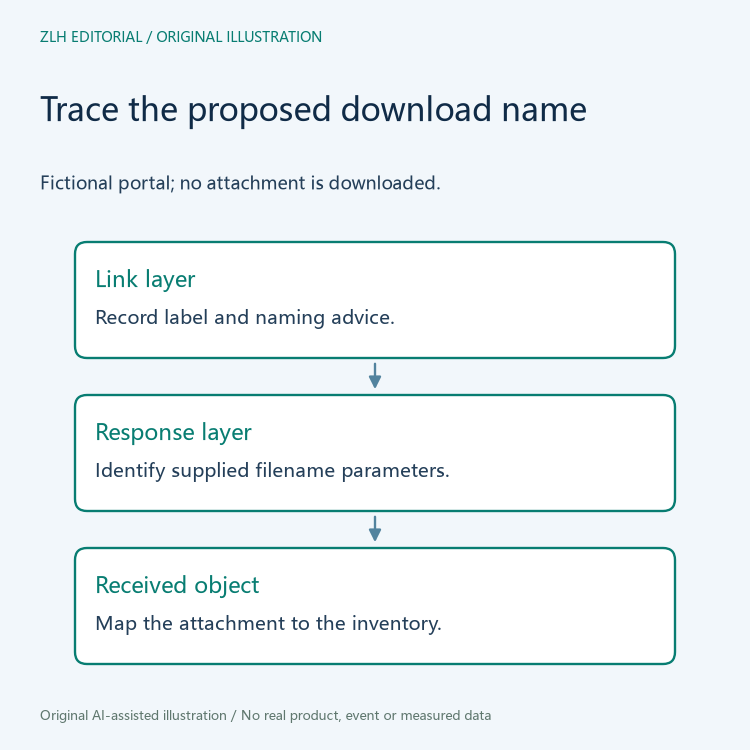
A proposed filename in a robot trade document portal can help a person save an attachment, but it does not prove the attachment's identity or content. The name suggested by a link, the name advised by a server and the name finally saved need not be treated as one documentary fact. This article reviews those layers through a fictional handover. It does not download a trading file, alter a portal or interpret shipment terms.
Record the visible label and the suggested name separately
Imagine a fictional portal with a link labelled Equipment schedule. Its suggested download name contains another description. The reviewer should retain both strings and request an explanation, rather than choosing the more plausible one as the official document title. A label describes the link as presented to the reader, while a filename is part of the file-handling context. Their relationship should be stated, not assumed.
A useful handover entry identifies the page version, link target and any filename advice supplied with it. It should also point to the document inventory that the attachment is supposed to satisfy. If the provider supplies only a screenshot, the review can describe the visible label but should not fabricate the underlying link attributes or response headers. Missing layers remain missing until the provider supplies them.
Read the HTML download value as a recommendation
The WHATWG HTML Standard's download section describes the download attribute and the treatment of suggested filenames, including response information and origin-related conditions. The value is not a blanket guarantee that every environment saves a resource under that exact string. Its meaning belongs within the documented download process rather than being a declaration about the truth of the attachment.
For the fictional portal, ask whether the proposed name comes from the link or another part of the process. Avoid accepting a generic statement that the browser always uses the visible label. This article has not compared browser behaviour, so it offers no compatibility result. It asks for the project's intended behaviour and separates that intention from any observations supplied later during a real handover review.
Read server filename advice within its response scope
RFC 6266 defines the HTTP Content-Disposition response field and its filename parameters. It treats a supplied filename as advisory and discusses recipient handling. A document reviewer should therefore preserve the actual field when it is supplied, while avoiding the inference that a convincing filename authenticates the bytes or establishes what business document the file contains.
The fictional provider might include a response excerpt together with a saved file. Request a clear association between that excerpt and the attachment version. A header copied from an unrelated example is not evidence about the delivered object. Equally, a local rename after download should be documented as a local naming action, rather than described as proof that the server originally returned the same name.
Use the inventory to identify the received document
A receiving record should connect the actual attachment to the intended item in the handover list. That requires the document's own identification and the provider's explanation of its role. A file called final does not establish final approval, and a filename containing a date does not automatically define the date of the underlying information. The reviewer should request those meanings explicitly where they matter.
If two attachments save under similar names, preserve both identities and ask how they differ. Do not overwrite one merely to make the folder look tidy. This is a documentation recommendation, not a report that such a collision happened. A later reviewer needs enough information to trace which object was examined, even when the portal's naming advice or a recipient's local naming convention changes.

Accept the naming explanation without expanding its claim
A clear handover finding can name the visible link label, the supplied filename advice and the received attachment identified in the inventory. It should say which layers were actually reviewed. If the saved name was not observed, keep that open. The finding does not establish that the attachment is complete, accurate, approved or suitable for a particular trade task; those questions need their own review.
Retain the provider's explanation when a proposed name differs from the document's internal title. The difference may be intentional, but its reason should not be invented by the recipient. Recording the explanation makes future revisions easier to recognise and avoids carrying an unsupported interpretation from one delivery into the next.
Additional reading is organised in the technical material category and related resource category. These category entrances do not verify a trade file. Reading naming layers carefully gives the document handover a clearer chain of identification while leaving content and commercial conclusions attached to the evidence that can actually support them.


