

Robot Trade File Maintenance: Read HTTP Age and Date
2026-11-05
Robot Trade File Maintenance: Read HTTP Age and Date
HTTP Age and the Date field describe aspects of a response message, rather than directly dating the business document retrieved through it. A robot trade file maintenance note should identify those objects before calling a document new, old or revised. This article uses a fictional read-only retrieval record and official HTTP specifications. It does not fetch a trade attachment, calculate a document's age or interpret any commercial deadline.
Identify which date the maintenance question concerns
Imagine a fictional handover containing an attachment, a response excerpt and an internal document revision label. The reviewer sees different time information and asks which is correct. They may describe different objects. Start by naming the response message, the attachment version and the provider's stated revision meaning. Do not force them into a single date merely because each appears in the same delivery package.
Retain the original fields and their source positions. A screenshot without a field name should not be interpreted as a complete response record. Likewise, a filename containing a date is not an explanation of what that date represents. The maintenance note should ask the provider to identify the relevant object and meaning, while preserving the unresolved relationship instead of silently choosing the most recent-looking value.
Read Age as an estimate about the response
RFC 9111's Age definition describes the sender's estimate of time since the response was generated or successfully validated at the origin, expressed as non-negative seconds. It also warns that absence of Age does not imply the origin was contacted. This is cache-response context, not a measurement of how long the attached document's contents have been unchanged.
For the fictional record, a reviewer can identify whether an Age field was supplied and preserve its context. Do not translate it into days since a robot quote was written, or use a missing field to claim a fresh origin retrieval. This article supplies no numeric Age example because no actual response was observed. Any later calculation would need its own input record and clearly defined purpose.
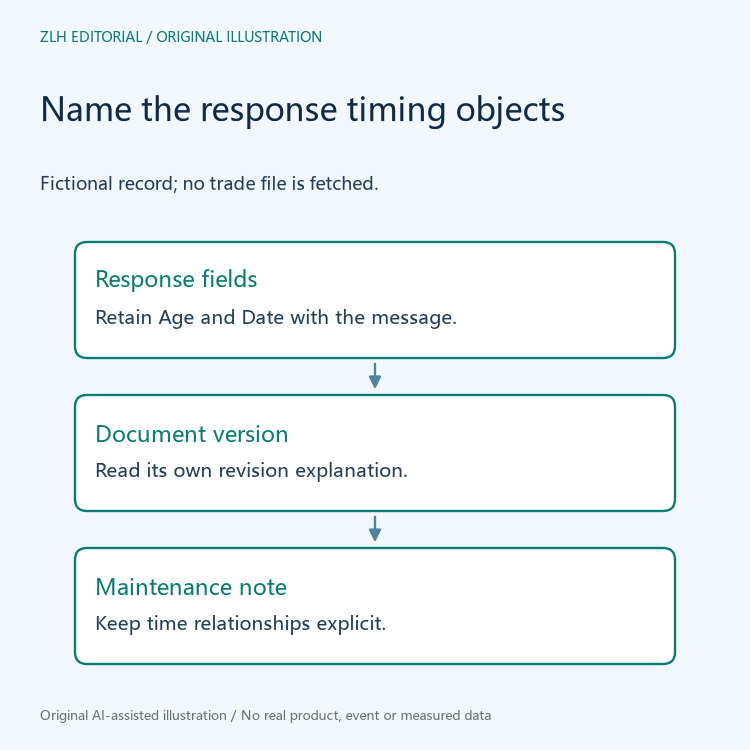
Read Date as message origination information
RFC 9110's Date definition describes the date and time at which the message originated, with requirements and qualifications for senders and recipients. It does not define a document's editorial revision date. The reviewer should therefore keep the response field attached to its message and request the document's own revision explanation separately when that matters.
In the fictional handover, a recent-looking Date should not automatically replace an older revision label inside the attachment. The response may be generated at a different time from the content it carries. The provider should explain the document version through its own records. Conversely, an older response field is not by itself proof that the business material is obsolete or unsuitable for a particular task.
Keep cache context separate from content review
Understanding response timing does not establish that an attachment is complete, accurate or the intended delivery. The fictional maintenance pack should still identify the actual file and its place in the document inventory. A cache-related field can help explain the retrieval context while leaving content questions unanswered. It should not become a substitute for examining the document or confirming its version with the provider.
If the same file is retrieved again, preserve the new observation rather than merging response fields from separate requests. Each excerpt needs its own request context. A later Date or a different Age value should not be narrated as a document revision unless the actual material and version record support that conclusion. This article reports no second retrieval or observed content change.
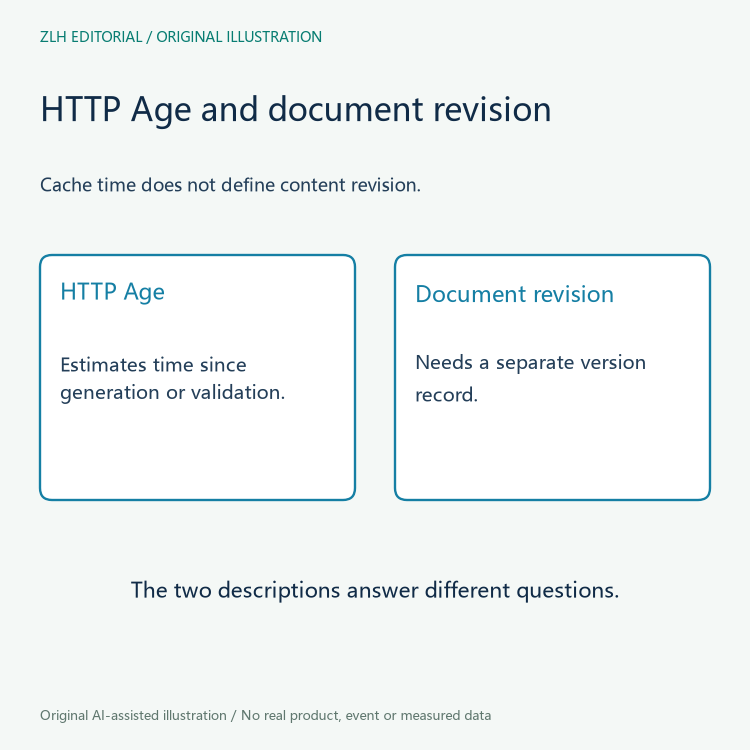
Write a maintenance note with named time objects
A clear finding separates supplied Age, supplied Date, observation time and the document's stated revision information. It should identify which relationships remain unexplained. This makes the record useful without pretending that every time field should agree. If the provider later clarifies a revision, retain that explanation with the corresponding attachment version rather than rewriting a response field's meaning.
The note can also state the exact question being investigated, such as identifying the current document version. That prevents a technical response-timing observation from drifting into an assertion about a quote's validity or another commercial term. Those matters need their own authoritative material, which this fictional exercise does not supply or interpret.
Additional reading appears in the technical material category and related resource category. These category entrances do not verify trade documents. Keeping response age, message date and document revision distinct gives later reviewers a precise account of the retrieval evidence and its limits.


