

Robot Gripper Offers: Parallel and Encompassing Modes
2026-11-05
Robot Gripper Offers: Parallel and Encompassing Modes
A robot offer may describe its gripper as both Parallel and encompassing without explaining what those words mean for the supplied accessory. The March 2026 Robotiq 2F-85 and 2F-140 manual describes two grasping relationships produced by the mechanism in response to object geometry and relative position. That description should not be rewritten as two independently selected finger-control programs or as a promise that every offered workpiece will be held successfully.
Start with the manual's actual gripper family
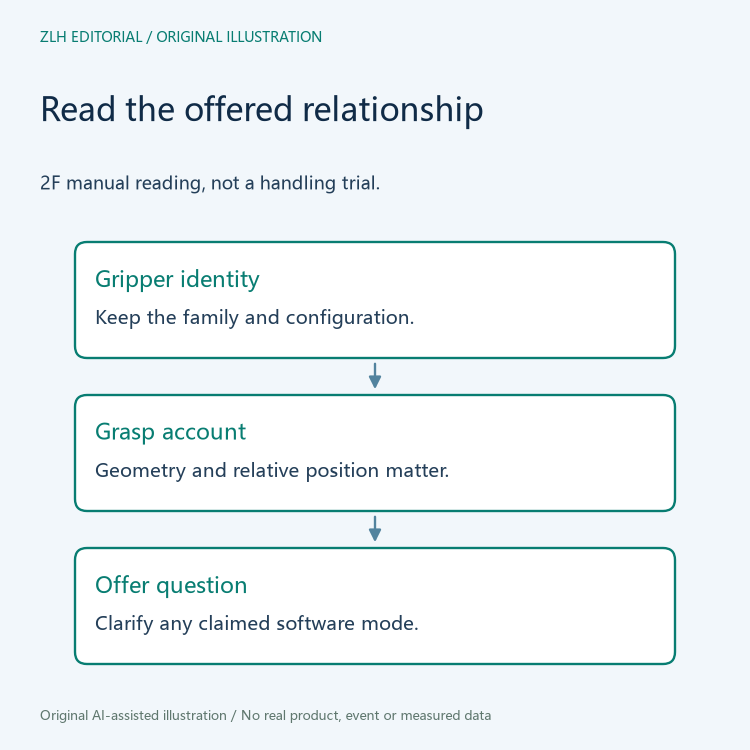
The inspected manual's General Presentation chapter explicitly identifies its 2F-85 and 2F-140 scope. It describes articulated fingers and an under-actuated arrangement, meaning fewer motors than the total number of joints. The object-picking explanation then describes a single actuator for opening and closing. Those are useful context for reading the two grasp terms, without turning the chapter into an operation guide.
The inspected instruction manual identifies its revision as March 17, 2026. A transaction reviewer should preserve that identity and ask which documentation applies to the offered unit. A modern product-family name or a photograph does not establish that the offered fingers, pads and configuration are the ones described. This article operates no gripper and makes no determination about a real accessory's condition.
Read parallel and encompassing as mechanical relationships
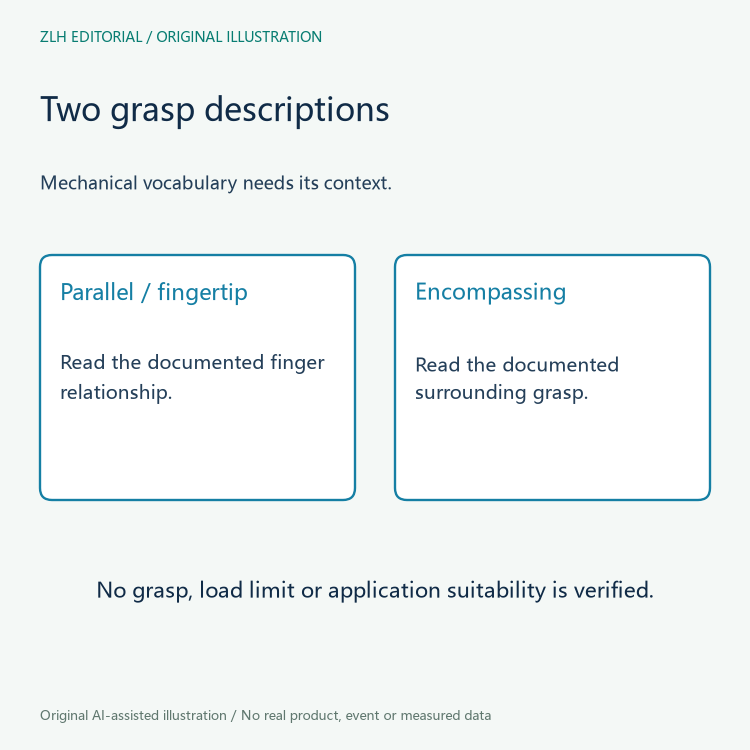
The manual explains that the grasp relationship depends on the object's geometry and its position relative to the gripper. It specifically notes that the same object may produce different grasp relationships under different relative conditions. A listing should therefore retain the demonstrated or proposed relationship instead of saying that a familiar object name fixes the grasp automatically in every case.
The two labels are also not a substitute for an actual task account. A supplier may state that the mechanism supports both relationships, while the buyer's proposed task uses only one. Those statements can coexist. The recipient should ask which relationship belongs to the specific offer and which evidence supports any claimed task behavior. No contact-position instructions, motion steps or setup recommendations are supplied here.
Do not read under-actuation as independently commanded fingers
Because the presentation describes articulated fingers, a reader could mistakenly assume that each visible joint has its own independently selected command. The manual's under-actuated and single-actuator descriptions limit that assumption. They help explain why the grasp can adapt mechanically rather than being selected merely by naming a separate software mode in a quotation.
A useful offer note can preserve the manufacturer's terms and ask the contributor to explain how their own control description relates to the mechanism. If a quotation uses an informal mode name, retain it as the supplier's wording until its meaning is clear. Do not silently translate it into a particular register, program or completed motion that the supplied evidence does not identify.
Keep fingertip and specification conditions visible
The Specifications chapter separately identifies finger and fingertip configurations and directs readers back to the grasp-relationship explanation. This reinforces the need to preserve the offered accessory configuration. A statement about a family mechanism should not erase which fingers or pads appear in the supplied equipment list. Nor should one diagram's conditions be copied to a different accessory merely because both have two fingers.
The separate product sheet, updated in May 2025, also names encompassing and pinch grips and identifies customizable fingertips. It explicitly treats its specifications as reference information and directs readers to the manual for official specifications. A concise sales sheet and a detailed manual can therefore play complementary roles, while neither establishes which pads or fingers a particular seller actually supplied. The reviewer should retain both document identities rather than letting the shorter sheet silently replace the configuration account.
The chapter includes mechanical specifications with stated configuration conditions. Here those conditions are used only to explain why a transaction needs an identified configuration. No numerical payload, force or opening limit is selected, transferred or calculated. Interpreting the grasp vocabulary does not establish the load that an actual offered gripper can carry or whether it suits a new application.
Resolve a fictional offer ambiguity without inventing a trial
Imagine a fictional offer stating that the included 2F accessory has two software-selected grasp modes. It attaches the manual but no explanation of the supplier's phrase. A reviewer can ask whether the phrase describes the mechanically produced grasp relationship in the manual or some separately documented project behavior. That is a documentation question, rather than evidence that a product feature is missing or that the offer is false.
If the supplier clarifies the phrase, retain the answer with the offered configuration and the original question. A separate claim that the accessory already handled the buyer's workpiece would still need its own observation account. The clarification does not create a test result. This example contains no real offer, handled object, holding measurement or completed demonstration.
The site's robot trade documentation and gripper offer reading notes provide related material. A precise Parallel and encompassing description lets both parties discuss the same mechanical vocabulary. Condition, compatibility and task suitability remain questions for evidence about the actual supplied system.
Primary references: Robotiq 2F instruction manual, March 2026; Robotiq Adaptive Grippers product sheet, May 2025.


