

Lidar Trade Image Records: Staggered and Destaggered Rows
2026-11-05
Lidar Trade Image Records: Staggered and Destaggered Rows
Lidar Trade Image Records can show two different-looking images derived from the same kind of retained frame data. Ouster distinguishes staggered columns organized by measurement time from a destaggered image organization aligned by azimuth. A trading appendix should name that layout before interpreting the appearance. This article reads current SDK documentation only. It connects to no sensor, opens no recording, rearranges no data, and makes no observation about an offered lidar's condition.
Staggered columns share a measurement-time reference
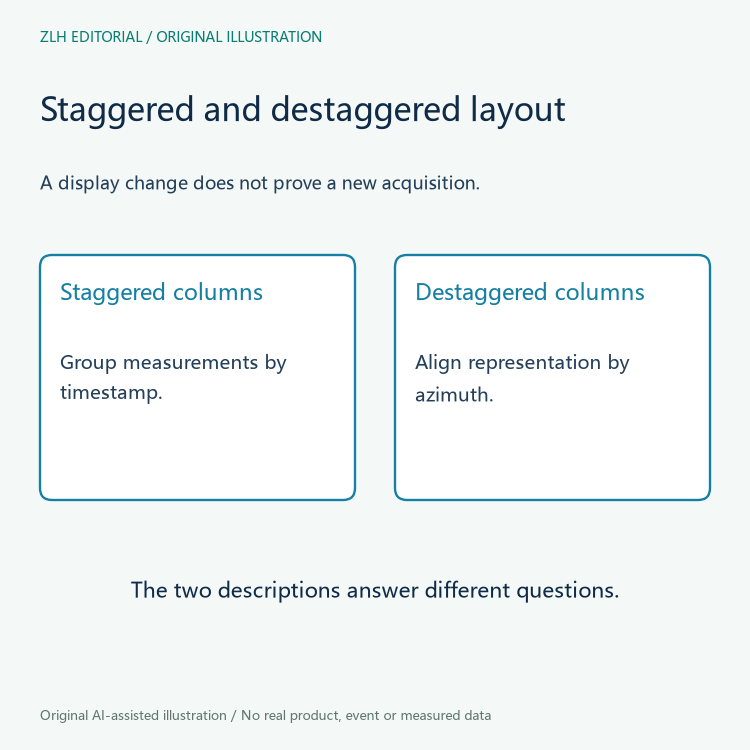
The official XYZLut and Destaggering explanation describes the default LidarFrame representation as staggered. A column contains measurements taken at one timestamp, while beams associated with that time point have different azimuths. A directly displayed two-dimensional field therefore need not look like an ordinary image arranged by viewing direction.
Suppose a fictional seller supplies a range-field screenshot with slanted-looking structures. The reviewer should ask whether the image retains that staggered layout before declaring that the lidar has a geometric fault. This is not a finding that any particular image is normal or defective. It is a request for the representation context needed to understand what a column means.
Destaggering changes the organization used for visualization
The same explanation describes destaggering as rearranging columns to correspond to azimuth instead of timestamps. Its discussion of reversing that representation refers to reapplying per-row pixel shifts. The important point for a trade appendix is that the layout changes. A different appearance is not, by itself, evidence of a new acquisition, an object moving, or an improvement in the sensor's physical resolution.
A contributor can identify the source frame, field name, layout, and associated metadata without asking the buyer to infer them from the image. Keep the original capture identity attached to derived displays. A range display, reflectivity display, and other field visualizations should retain their own field identities even when their array shapes happen to match.
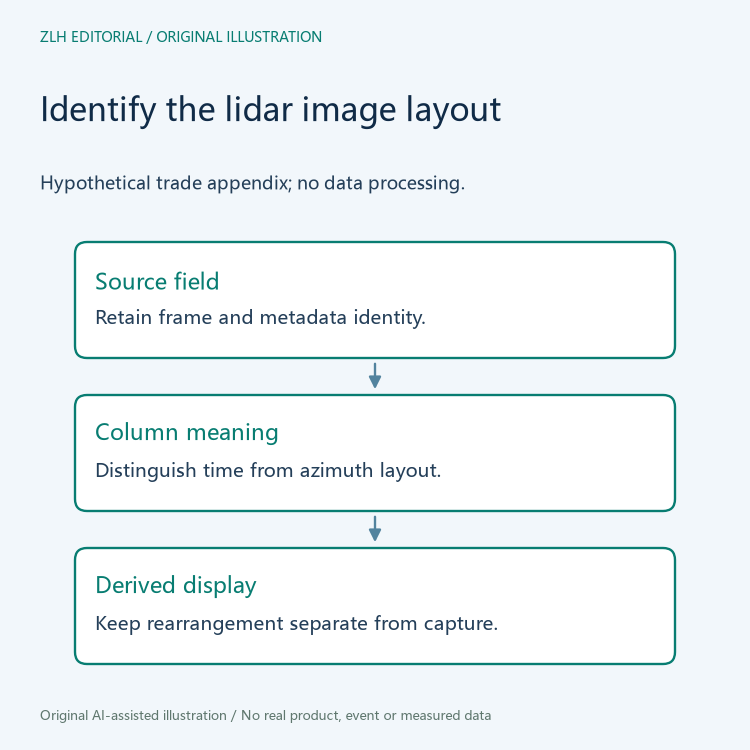
The reverse-layout reference also retains metadata context
The official core.data API reference describes stagger as returning a staggered copy of provided fields and identifies the associated sensor metadata input. It contrasts timestamp-organized and azimuth-organized columns, and describes returning the same array shape. Shape preservation does not mean that each displayed column keeps the same interpretation through a layout change.
This article uses the current pages, which identify their latest SDK documentation version as 1.0.1 at review. It does not assume that older examples use the same class names or API organization. A hypothetical handover based on another SDK release should retain its own reference rather than silently relabeling its objects to match a newer page.
Do not confuse image arrangement with motion compensation
The cited layout explanation concerns organizing a retained field for visualization. It does not turn an array rearrangement into evidence of a stationary scene, synchronized external sensors, or an accurate motion-compensated model. If a supplier makes those additional claims, request material that addresses them directly. The layout label alone does not supply that evidence.
A useful hypothetical record can separate the original capture, its sensor metadata, the selected field, the stated representation, and any derived display. If only an image is supplied, record that limitation. Do not generate missing timestamps or infer a complete metadata file from a plausible-looking scene. The article has not examined a real packet stream or measured any angular offsets.
Side-by-side captions should explain the difference actually intended. “Staggered” and “destaggered” identify representation choices; “before repair” and “after repair” assert a history that would need different evidence. If the same source data was only rearranged for presentation, preserve that derivation instead of suggesting that the hardware was repaired between screenshots.
Likewise, a revised illustration does not establish that a seller has supplied a new sensor. Keep a display correction, a software processing change, and a hardware substitution as separate events in the documentation. Each requires its own source if it is claimed. This distinction helps a buyer ask an answerable question without treating every visual difference as a product change.
Array dimensions can still be worth recording, but their meaning should remain attached to layout. An unchanged height and width do not tell a reader whether adjacent columns group simultaneous measurements or angular directions. Ask the contributor to retain the layout statement beside any dimensions. A general label such as image size cannot supply that missing relationship. This avoids treating equal-looking matrix shapes as a complete explanation of the underlying organization.
The two original illustrations use only conceptual labels. They contain no point cloud, range image, row-shift values, or invented defect. Continue through the robot trading documentation section and related resources section. Naming whether columns represent time or azimuth makes a lidar image appendix more readable while keeping sensor-condition conclusions tied to actual condition evidence.


