

Robot Camera Timer Records: Delay and Output Duration
2026-11-05
Robot Camera Timer Records: Delay and Output Duration
Timer Records in a robot camera's transaction appendix should distinguish the delay before an internal timer output goes high from the duration of that high output. A status labeled TimerActive introduces a further distinction: it need not mean that the output is already high. Basler's documentation explains these relationships within model-specific timer behavior. This article reads that material without applying a trigger, changing a timer or observing an electrical signal.
Identify the selected timer and camera family
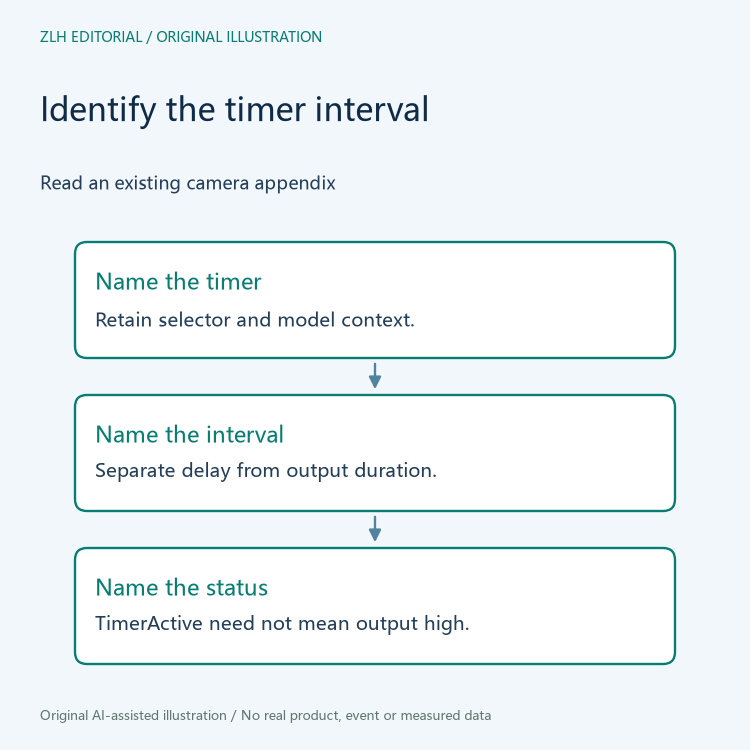
A retained parameter table should name the timer instance, the camera model and the source context. The word timer by itself does not show which timer was selected or which family's timing description applies. An editor should preserve these identities before turning a list of parameter values into a timing statement for an offered device.
The official Timer feature page separates camera families and includes availability tables. Some families have two timers in its feature description, while older families have a single timer. This is a model-scoped account, not permission to assume that every device provides the same number of independently selectable timer instances.
Read delay before the output-high interval
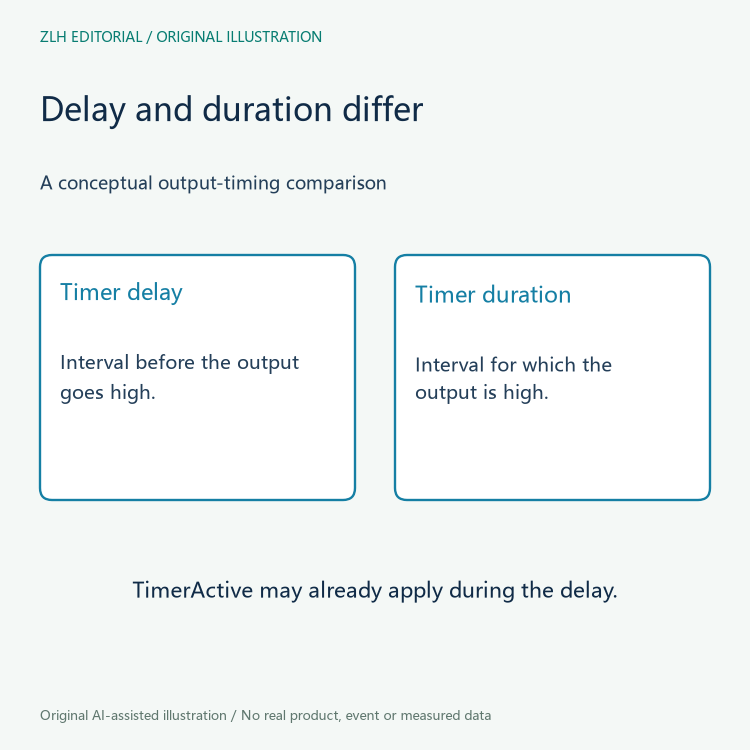
The feature description explains that the timer starts when it receives a qualifying trigger, with a delay before the internal output goes high. TimerDelay belongs to that waiting interval. It should not be renamed the duration of the high output merely because both values occur within one timer sequence.
Likewise, a parameter copied from an existing appendix does not independently measure the complete interval from an external event to an image arriving at a host. That broader interval involves an identified event chain and its own evidence. The timer's documented delay is narrower than an unsupported end-to-end acquisition or communication latency claim.
Read duration at the output scope
The source describes TimerDuration as the interval for which the timer's internal output remains high after the delay. Keeping this output scope visible prevents a common caption error: adding a generic active-time label that conceals whether the contributor means the signal, the timer's status or some other operation.
A clear explanation can name the delay and the output duration separately without supplying recommended settings. The original comparison diagram contains no scaled waveform or observed electrical trace. It is a conceptual distinction between the intervals, with no values chosen for any actual camera, light or connected equipment.
Do not equate TimerActive with output high
For the newer-family behavior described on the page, TimerStatus becomes TimerActive immediately when the timer starts, including the delay before the output goes high. The page also describes an arm delay and its relationship to readiness for another trigger. When that arm delay remains in effect, the active-status interval can extend beyond the output-high duration.
Consequently, a status entry alone should not be captioned as proof that the internal output was high at the same instant. The source distinguishes the status and output sequence. A transaction note should preserve that distinction and identify which field or retained observation the contributor actually supplied. This article offers no diagnosis of a real device.
Keep family-specific parameter names intact
The feature page also covers classic camera families with their own parameter naming and time-base context. These sections should not be merged into a synthetic universal timing model. A recipient should retain the applicable family section rather than substitute a similarly named field from a different part of the documentation.
The official TimerSelectorEnum reference lists timer selections with their applicability. Its broader enumeration includes timer names beyond the two in some feature descriptions. That is a reminder to read support scope, not evidence that an unknown offered camera supports every listed selection. No device feature list was queried here.
Review a fictional timing summary
Imagine a fictional seller's appendix that labels a TimerActive record as an output-high measurement, then treats TimerDuration as the entire time from trigger to completed image delivery. A reviewer should ask what the retained field represents and which evidence supports the broader timing claim. Both interpretations exceed the definitions supplied by the timer record alone.
The correction can restore the named status, delay and output-duration meanings without inventing a missing signal trace. If a later attachment includes an actual measurement, its event definitions and relationship to the selected timer still matter. This invented example contains no equipment response, time value or transaction finding.
Keep the documentary conclusion narrow
Both official pages were read on November 5, 2026, including family differences, availability entries and timing notes. No source example was executed. Related material appears in the robot camera transaction collection and article directory. Timer Records become more useful when the delay, output duration and active status keep their documented identities before a reader considers any separate performance claim.


