

SWIR Camera Reading: Wavelength and Material Contrast
2026-11-06
SWIR Camera Reading: Wavelength and Material Contrast
SWIR Camera Reading begins with a spectral question: which wavelengths reach the sensor, and how does the material respond at those wavelengths? Two objects that look similar to a person can produce different infrared contrast. Conversely, a surface that appears opaque in visible light may transmit a selected longer wavelength. Sony's SenSWIR explanation connects those material properties to a detector capable of imaging across visible and short-wavelength infrared light.
Identify the spectral range before comparing cameras
The official SenSWIR technology page describes short-wavelength infrared light using a general range of roughly 900 to 2,500 nanometers, while its illustrated SenSWIR sensitivity spans approximately 400 to 1,700 nanometers. These statements have different subjects. A general region of the electromagnetic spectrum is not automatically the sensitivity range of every sensor bearing that region's name.
For a used-camera information sheet, preserve the actual model and its stated range. Calling a device SWIR does not establish that it detects the entire broad region. The visible extension is also useful context: the same sensor technology can support a visible-light view and selected infrared views, but the illumination and filtering account still determines what a particular image represents.
Separate the light-receiving material from the readout circuit
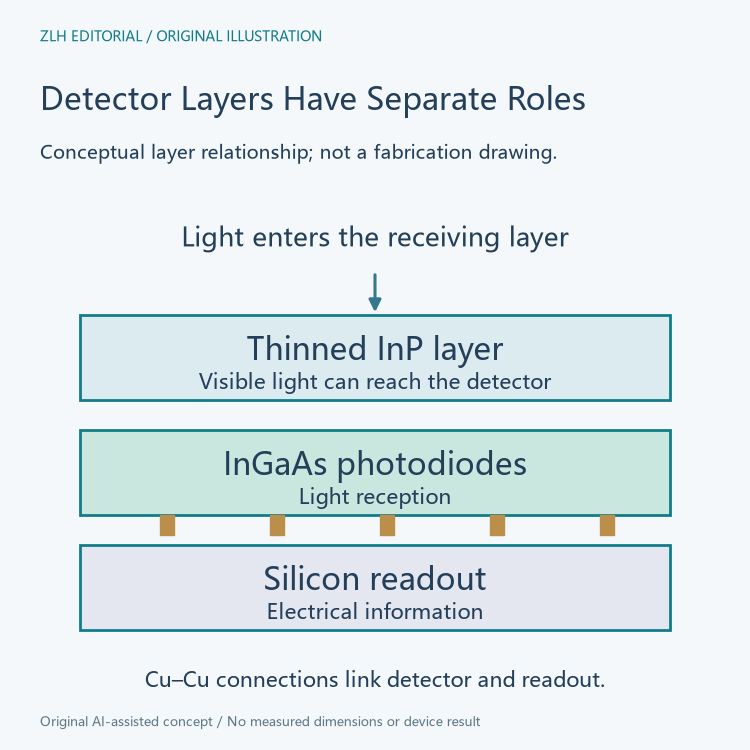
Sony describes an indium gallium arsenide, or InGaAs, photodiode layer connected to a silicon readout circuit. Its copper-to-copper connection technology permits a compact arrangement without the conventional bump connection described in the comparison. The photodiode's role is light reception, while the readout circuit handles the resulting electrical information. These are cooperating parts with different functions.
The technology page also explains thinning the indium phosphide layer above the photodiodes so that visible light can reach the light-receiving region. This structural explanation is more informative than treating the visible extension as a software color mode. A displayed picture and a sensor's physical spectral response belong to different stages of the imaging system.
Use absorption differences to explain contrast
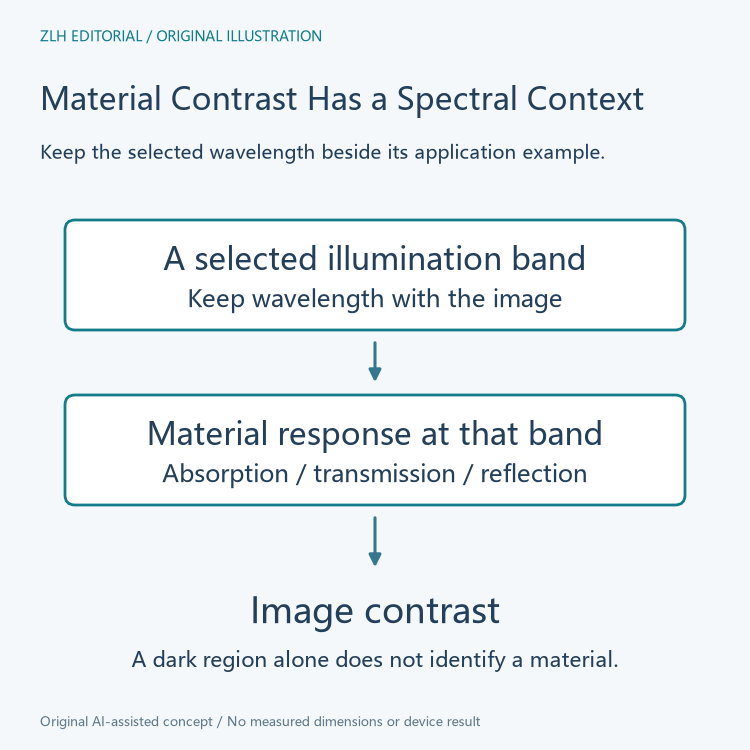
In Sony's water examples, imaging around 1,450 nanometers makes water appear dark because of its absorption at that wavelength. The useful contrast comes from a material response under the cited spectral conditions. It does not mean that every dark region in an arbitrary SWIR image is water, nor that visible brightness alone predicts the infrared appearance of a material.
This distinction helps when reviewing a supplier's sample picture. Ask for the illumination band, filtering, camera model and material context alongside the image. A visible photograph and an infrared photograph may emphasize different properties even when they show the same object. Their contrast cannot be interpreted solely by matching familiar visible colors.
Transmission is also material and wavelength dependent
The technology explanation shows examples of imaging through selected resin packaging and silicon at specified infrared wavelengths. Its silicon example uses 1,550 nanometers to reveal features through a wafer. These examples explain why a different spectral band can expose otherwise hidden structure. They do not make every opaque package or every thickness transparent to every SWIR camera.
For a camera trade record, describe the sample as the manufacturer's application example and retain its wavelength. The offered camera's lens, filters and illumination belong in their own entries. A sensor model name identifies one component; it does not supply the complete optical path or establish the condition of a second-hand imaging assembly.
Multispectral color is a representation of selected bands
Sony explains combining images from different wavelengths into a multispectral representation. Such a display can make material differences easier to recognize. The assigned display colors need an accompanying explanation, because they can encode responses in chosen infrared bands rather than the colors that the human eye would see under ordinary illumination.
A useful appendix can distinguish the selected bands, the captured grayscale responses and the later color assignment. That separation allows a reader to understand why two apparently similar materials receive different display colors. It also preserves the distinction between the underlying images and any subsequent material classification performed by an application.
Keep sensor specifications beside the technology account
Sony's official SWIR product overview lists individual models with different pixel counts, pixel sizes, frame rates and output interfaces. Those entries show why a technology family should not be summarized as one interchangeable specification. A comparison table should name the exact model before attaching a numerical performance entry.
Both official pages were read on November 6, 2026. The original diagrams explain layer responsibilities and spectral contrast without reproducing manufacturer images or presenting measured transmission curves. Related material appears in the robot vision accessory collection and article directory. The central relationship is between wavelength, material response and detector sensitivity; a finished inspection result adds its own optical setup and interpretation.


